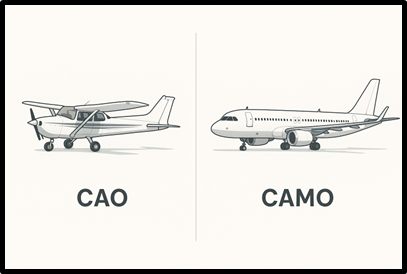
In the world of aviation maintenance and continuing airworthiness, regulatory clarity is critical. Among the numerous European Union Aviation Safety Agency (EASA) approvals, two commonly referenced types are Part-CAO (Combined Airworthiness Organization) and CAMO (Continuing Airworthiness Management Organization).
While they share some similarities, these approvals serve distinct purposes and apply to different operational contexts. Understanding their differences is essential for operators, aircraft owners, and maintenance professionals.
Background: EASA’s Evolving Framework
EASA continuously adapts its regulatory framework to improve efficiency and safety. The introduction of Part-CAO in 2020 was a key milestone intended to simplify the oversight of general aviation maintenance activities. It replaced and consolidated several older approval schemes like Part-M Subpart F and Part-M Subpart G, providing a unified approach.
On the other hand, Part-CAMO was introduced to enhance safety oversight, specifically incorporating Safety Management System (SMS) requirements for commercial and more complex aircraft operations.
What is a Part-CAO Organization?
A Part-CAO is a multi-functional approval that allows organizations to conduct maintenance, continuing airworthiness management, airworthiness reviews, and permit-to-fly issuance under one umbrella specifically created for non-complex aircraft and non-commercial operations.
Key Features:
-
- Designed for General Aviation.
-
- Suitable for non-complex aircraft, including light aircraft, helicopters, balloons, and sailplanes.
-
- Enables organizations to perform:
-
- Maintenance (formerly Part-M/F)
-
- Airworthiness Management (formerly Part-M/G)
-
- Airworthiness Review (for aircraft under its management)
-
- Issue of permit to fly
-
- Enables organizations to perform:
-
- Simplified oversight requirements and reduced administrative burden.
-
- No mandatory SMS requirement, which aligns with the lower risk profile of its target operators.
Ideal For:
-
- Flying clubs, maintenance shops working on private aircraft, non-commercial aircraft owners/operators, small Approved Training Organizations (ATO) flying light aircraft.
What is a CAMO Organization?
A CAMO organization is focused exclusively on the airworthiness management aspect for aircraft. It’s a more stringent and structured approval compared to Part-CAO, suitable for commercial air transport and complex aircraft.
Key Features:
-
- Applicable to commercial operations and complex motor-powered aircraft.
-
- Focuses solely on:
-
- Airworthiness management
-
- Airworthiness reviews (if granted)
-
- Permit to fly arrangements
-
- Focuses solely on:
-
- Mandatory Safety Management System (SMS) integration.
-
- Higher level of organizational oversight, personnel qualifications, and documentation.
Ideal For:
-
- Airlines, business jet operators, lease companies, commercial air operators
Part-CAO vs. CAMO: A Comparative Summary

Conclusion: Choosing the Right Approval
The choice between Part-CAO and CAMO comes down to the type of aircraft and nature of operation. For general aviation and light aircraft maintenance, Part-CAO offers a cost-effective, flexible, and streamlined solution. Conversely, CAMO is the standard for managing the airworthiness of complex or commercial aircraft, ensuring a higher level of safety assurance by using safety management systems.